

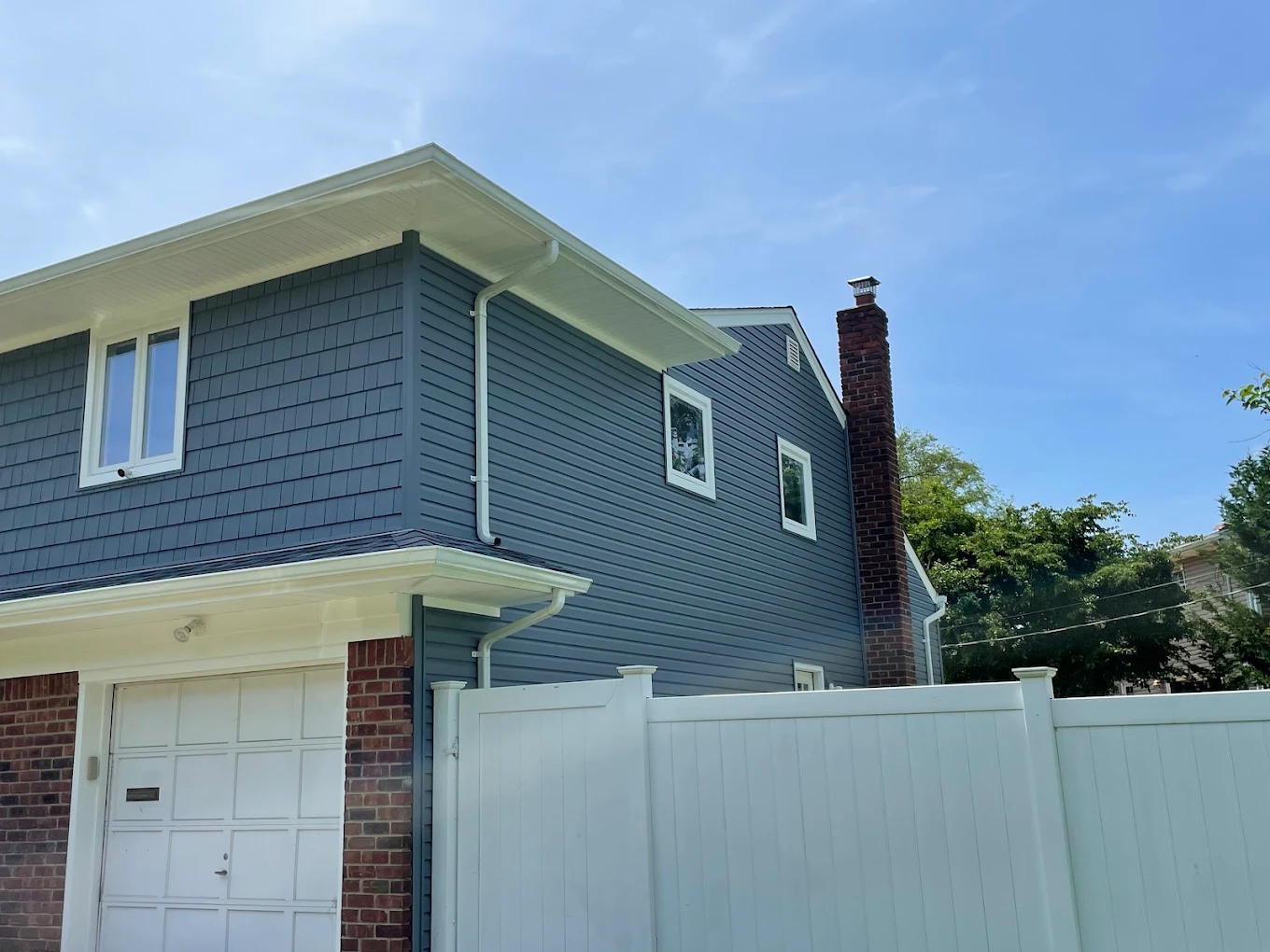
If a storm just hit your house, don’t panic, and do the following:
- Stay off the roof, stay out from under any sagging ceiling, and treat every downed wire as live.
- Stop water from getting in, then photograph the damage from the ground and from inside the house.
- Within 48 to 72 hours, get a licensed Suffolk County roofer to inspect the roof and tell your insurer in writing. Don't sign anything on your doorstep.
The rest of this guide walks through each step in order, explains the decisions that cost people money (filing a claim, picking a contractor, and how the new roof is fastened), and covers what's specific to Huntington.
We're a roofing contractor in Huntington, New York, and we've written this the way we'd explain it to a neighbor standing in the driveway.
Why Your Roof May Be Damaged Right Now
If your roof took a beating in the September 25 to 28 nor'easter and nobody has looked at it yet, you're about five to six weeks in. That's still workable, but it's the point where small problems start turning into ceiling stains.
The latest storm resulted in more than 1,230 trees coming down and over 125,000 outages occurred across a 72-hour period. The National Weather Service's preliminary readings put gusts at 67 mph at Eaton's Neck, on the Northport side of the Town, with 3 to 6 inches of rain across parts of Long Island.
Wind damage to a roof doesn't always announce itself. Shingles can be creased or lifted without falling off, and a roof can look fine from the street while water is getting in at a nail line. If there was a storm and you've seen a stain, a drip, shingle pieces in the yard, or a bent gutter, assume there's something to find.
Now, let’s go step by step.
Step 1: Make It Safe (First Hour)
- Stay off the roof. Wet, wind-damaged shingles are slick, and the decking underneath may be weakened. There is nothing useful you can do up there that a roofer can't do better and more safely.
- If you see downed wires, keep clear and report them to PSEG Long Island at 800-490-0075 or call 911. If a tree is tangled in wires, tree removal can't start until the utility clears them.
- Check the top floor and attic for active drips, wet insulation, dark patches on the wood, or daylight coming through the roof boards.
- If a ceiling is bulging with water, keep everyone out of that room.
Step 2: Stop More Water from Getting In
Your policy will expect you to take reasonable steps to prevent further damage, so this matters for the claim as well as the house.
- Put buckets under drips and move furniture, electronics, and rugs out of the way.
- If a ceiling is bulging, letting the water out through a small hole at its lowest point can prevent a bigger collapse. Only do this if you are certain there's no light fixture, wiring, or fan above that spot. If you aren't sure, leave it and call a professional.
- Have a roofer put on an emergency tarp if shingles are missing or decking is exposed. Don't hammer a tarp down through the shingles yourself, because every nail is a new hole.
- Keep every receipt for tarping, board-up, and cleanup. Ask your insurer how it reimburses emergency work.
Not sure where a leak is coming from? Our guide to the most common causes of roof leaks will help you narrow it down.
Step 3: Document Everything Before Anything is Cleaned Up
Take timestamped photos and video of:
- Shingles, debris, and damaged gutters or siding, from the ground (binoculars or your phone's zoom are fine)
- Ceiling stains, wet walls, and damaged belongings, with wide shots and close-ups
- Fallen branches or trees, before anyone moves them
- The storm itself: write down the date, the time it hit, and what you saw
Keep damaged materials (shingle pieces, for example) until your insurer's adjuster has seen them.
Step 4: Call Roofer or Insurer First? Do Both, In This Order
You'll hear conflicting advice on this. Here's how we'd handle it:
A professional inspection tells you whether the damage is worth a claim or a simple repair. Don't let it turn into weeks of waiting, though. Insurers work to deadlines, and so do you:
- Under New York's claim rules, your insurer must acknowledge your claim within 15 business days, then has 15 business days to ask for more information and another 15 after receiving it to accept or deny, unless it explains in writing why it needs more time.
- Ask your agent whether calling to ask a question counts as filing a claim. Written notice to your insurer is what protects your timeline.
Step 5: Hire a Roofer After a Storm in Huntington
Your roof inspection will come to one of two conclusions: roof repair or replacement.
Roof repair makes sense when damage is limited to a small area, the rest of the roof is in good shape, and matching shingles are available. Roof replacement makes sense when creasing or missing shingles are spread across several slopes, the shingles are brittle or past their service life, or the decking underneath is damaged. Once it’s clear, you need to find a contractor who can help you with either one, and this is where you need to be careful.
Contractor fraud consistently ranks among New Yorkers' top five consumer complaints, and it climbs after storms. Your roofing contractor should have a verifiable Suffolk County license, proof of insurance, a written scope that names materials and fasteners, and a track record you can check.
Check the license in detail because New York State doesn't license home improvement contractors, but some counties do, and Suffolk County is one of them. Ask for the Suffolk County Home Improvement license number and check it with the county's Consumer Affairs office before work begins. A license from Nassau or another county doesn't cover work in Suffolk.
You should also know what the law requires of the contractor. Under New York's General Business Law § 771-b, roofing contractors must:
- Have a written contract with you before work starts
- Allow you to cancel within three business days after your insurer gives you written notice that the claim or contract isn't a covered loss
- Not advertise to pay or rebate your insurance deductible, or require a deposit above 50% of the contract price
Look for the red flags, and don’t work with them if you notice any:
- A door-knocker pushing you to sign today
- A contractor who wants you to sign over your claim before you've seen the scope of work
- No local address, or an out-of-state truck and a phone number with no history behind it
- A request for full payment up front. The Attorney General's office says never pay the full price up front, and you can report suspected scams there at 800-771-7755.
At Smart Choice Contracting, we’re licensed in both Suffolk County (#HI-62204) and Nassau County (#189141), and you can verify our track record: over 26 years of roofing, more than 2,000 roofs installed and repaired, and a 5.0 rating across 100+ Google reviews.
We handle everything under one roof, from inspection to repair or replacement, plus gutters and siding if the storm hit them too. Book a free estimate and talk to the owner directly.
Step 6: Decide Whether to File At All
Besides the roofer, you need to work with the insurer. A claim isn't automatically the right move. Work out three numbers first:
- Your deductible (the amount of money you must pay out of pocket before your insurance company pays for the rest). Find it on your policy's declarations page. It may be a flat dollar amount or a percentage of the home's insured value.
- A written repair estimate from the licensed roofer from step 5.
- What the repair costs relative to the deductible. If a repair costs $900 and your deductible is $1,000, filing won't pay anything.
Many Long Island policies carry hurricane deductibles of 1% to 5% of the insured value. On a hypothetical $500,000 dwelling limit, 2% is $10,000. A hurricane deductible is triggered by a hurricane, and a nor'easter isn't one, but some policies also carry a separate windstorm deductible that applies regardless of a hurricane declaration. Read your own declarations page rather than assuming.
What Storm Damage Looks Like on an Asphalt Shingle Roof
You may not know the terminology the adjuster and roofer will use, so here it is in plain English:
Signs to look for: missing shingles, creased or lifted tabs, exposed nails, a heavy build-up of shingle granules in the gutters, bent flashing, and stains on the ceilings below.
Your Next Seven Days After a Storm
- Today: safety check, stop active water, take photos.
- Within 48 to 72 hours: roofer inspection and written estimate.
- Same window: read your deductible and policy deadlines, then report to your insurer in writing if the repair is worth a claim.
- That week: compare two or three licensed roofers on materials, fasteners, and scope, not just price.
- After repairs: read how to prepare your roof for storm season so the next nor'easter finds you ready.
If you want a number to work from, you can request an instant quote.
Frequently Asked Questions
Will a storm claim raise my premium?
It can, but it depends on your insurer, your claim history, and the size of the claim. Ask your agent before you file, and ask specifically whether an inquiry is treated differently from a claim. If the repair is smaller than your deductible, paying out of pocket avoids the question altogether.
What's the difference between ACV and RCV coverage?
Replacement cost value (RCV) pays what it costs to replace the roof with new materials. Actual cash value (ACV) pays that amount minus depreciation for the roof's age and wear. Your declaration page says which you have, and the difference can be thousands of dollars on an older roof.
Can a roofer cover my deductible?
No. As covered above, New York law bars roofing contractors from advertising to pay or rebate it. Treat that offer as a warning sign.
Do gutters and siding go on the same claim?
Often, yes. Falling limbs and wind commonly damage the gutters and siding at the same time as the roof, so have your inspector look at all three and put everything in one estimate.